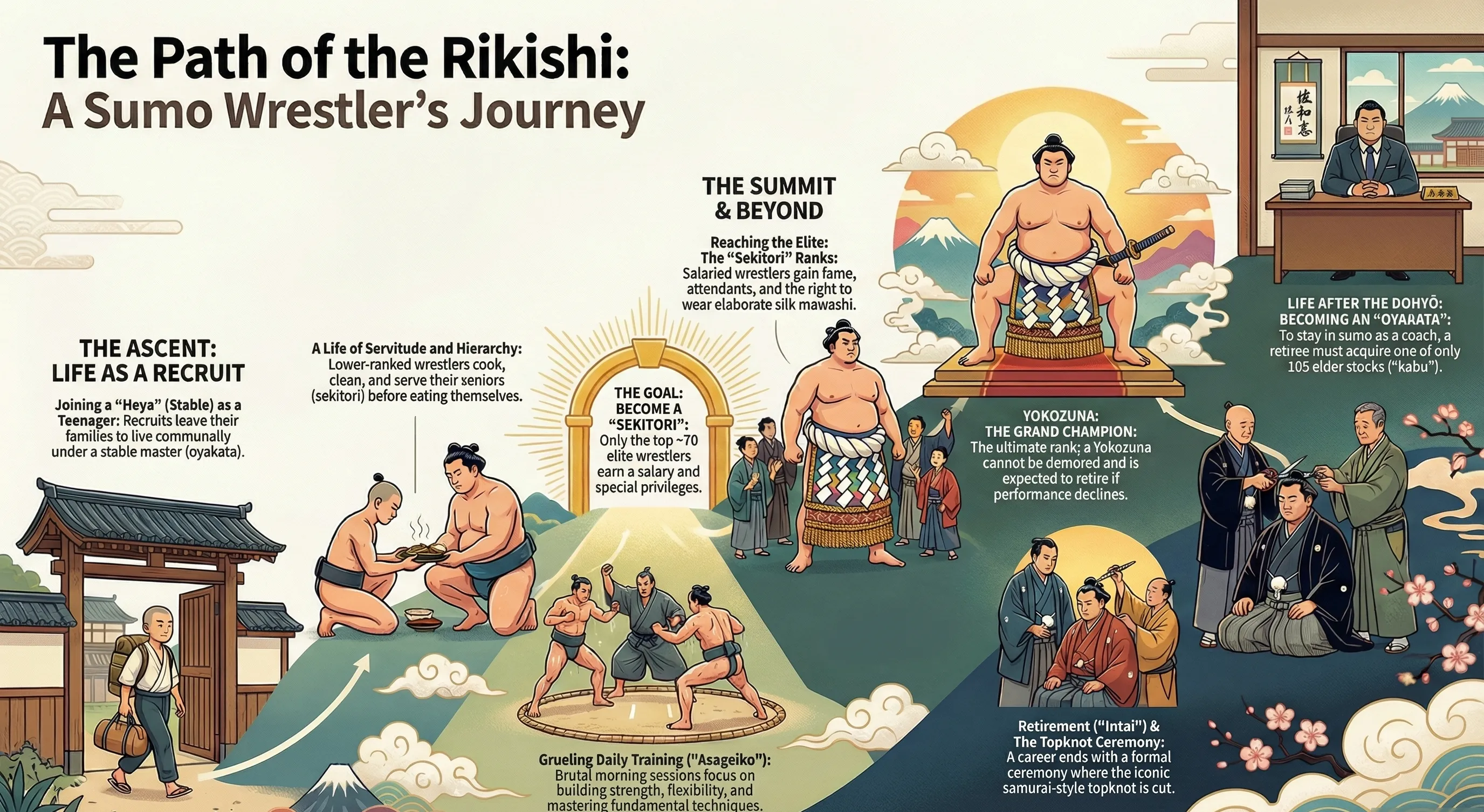
Introduction: Understanding the Language of the Dohyo
To truly appreciate the rich tapestry of professional sumo, one must first become acquainted with its unique and extensive vocabulary. This specialized language, steeped in centuries of tradition, governs every facet of the sport, from the intricate ranking system and powerful combat techniques to the solemn cultural rituals and the highly structured daily life of its practitioners.
This glossary serves as a comprehensive guide to this lexicon, drawing exclusively from historical accounts and expert analysis to illuminate the complex world of Japan's national sport. Our journey into the language of sumo begins, fittingly, with its central figure: the wrestler, or rikishi.
🎯 How to Use This Glossary
- Terms are organized by thematic sections for easy learning
- Use the quick navigation above to jump to specific topics
- Each term includes context and historical significance
- Related terms are cross-referenced for deeper understanding
1.0 The World of the Rikishi: Ranks, Roles, and Identity
The world of professional sumo is defined by a rigid and uncompromising hierarchy. This ranking system, known as the banzuke, is far more than a simple ladder of athletic achievement; it is a visible manifestation of the sport's deep-seated feudal social structures. It serves as the central pillar of the sport, dictating every aspect of a wrestler's life, from salary and privileges to daily chores and the order in which they eat and bathe.
1.1 The Ranking Hierarchy (Banzuke)
The following list outlines the primary ranks within the sumo world, presented in descending order of precedence.
1. Yokozuna (横綱) - Grand Champion
The sport's ultimate rank. Historically, yokozuna was not a formal rank but an honorary title for powerful ōzeki permitted to perform a special ring-entering ceremony. It was not officially listed as a rank on the banzuke until the 16th yokozuna, Nishinoumi Kajirō, insisted upon it in 1890.
Important: Since 1951, promotion has been the responsibility of the Japan Sumo Association (Sumō Kyōkai), based on recommendations from the Yokozuna Deliberation Council (YDC), which carefully considers not only a wrestler's performance but also his perceived possession of hinkaku (dignity).
Unlike all other ranks, a yokozuna cannot be demoted; upon a decline in performance, he is expected to retire. This principle was powerfully demonstrated in 1954 when Azumafuji voluntarily retired to allow for Ōzeki Tochinishiki's promotion, as the sport already had four active grand champions.
2. Ōzeki (大関) - Champion
The second-highest rank in sumo. Before the formalization of yokozuna, ōzeki was the sport's highest official rank. It remains a position of immense prestige and is a prerequisite for any wrestler aspiring to become a grand champion.
3. Sanyaku (三役) - The Three Ranks
This is the collective term for the three junior champion ranks that fall below yokozuna and ōzeki. Wrestlers in the sanyaku ranks represent the top tier of competitors and regularly face the highest-ranked opponents.
- Sekiwake (関脇): The third-highest rank in sumo. Achieving this rank signifies a wrestler's entry into the elite of the sport.
- Komusubi (小結): The fourth-highest rank. Wrestlers at this rank are typically at the cusp of breaking into the top echelons of the sport.
4. Maegashira (前頭)
These ranks constitute the main body of wrestlers in the top makuuchi division. They are numbered from 1 down to approximately 17, with wrestlers in the upper numbers (e.g., maegashira 1) facing the toughest competition.
5. Jūryō (十両) - Second Division
The second-highest division in professional sumo. This is a critically important threshold, as wrestlers promoted to jūryō become salaried professionals known as sekitori, gaining significant privileges and status.
6. Lower Divisions
These are the unsalaried apprentice divisions where young wrestlers learn the fundamentals of the sport and perform daily chores in the stable. In descending order, they are:
- Makushita (幕下)
- Sandanme (三段目)
- Jonidan (序二段)
- Jonokuchi (序ノ口)
7. Banzuke (番付)
The official ranking document published before each grand tournament. Printed in a distinctive calligraphic style, it lists every active wrestler, elder, referee, and announcer in the sumo world, meticulously ordered by rank and affiliation.
View the current tournament schedule to see when the next banzuke will be released.
1.2 Key Roles Within the Sumo Ecosystem
Rikishi (力士)
The general term for any professional sumo wrestler, regardless of rank.
Sekitori (関取)
A professional wrestler ranked in the top two divisions (makuuchi and jūryō). Sekitori receive a monthly salary, are allowed to marry, and are attended to by junior wrestlers.
Oyakata / Shishō (親方 / 師匠)
An oyakata is a Sumo Elder and stablemaster who must acquire a highly coveted toshiyori myoseki (elder stock) to remain in the sport after retirement. The term shishō is synonymous and refers to the master or teacher of a sumo stable (heya).
Deshi (弟子)
An apprentice or disciple wrestler who lives and trains in a stable under the guidance of a shishō.
Tsukebito (付け人)
A junior wrestler assigned as a personal attendant or manservant to a high-ranking sekitori. Their duties can include everything from carrying their master's belongings to helping him bathe.
Gyōji (行司)
The referee who presides over each bout. Gyōji have their own ranking system parallel to the wrestlers and are distinguished by their ornate silk garments and the fan (gunbai) they use to signal their decisions.
Yobidashi (呼び出し)
The announcer or caller who calls the wrestlers to the ring before their match. Yobidashi are also responsible for the complex and physically demanding construction and maintenance of the clay dohyō.
Tokoyama (床山)
The highly specialized hairdressers responsible for crafting and maintaining the traditional topknot hairstyles of the wrestlers.
1.3 The Wrestler's Identity
Shikona (四股名) - Ring Name
A wrestler's ring name. Often symbolic, a shikona can be inherited from a former great wrestler, reference a wrestler's origins, or be granted by his stablemaster. It is common for a wrestler's shikona to change as he advances through the ranks.
Chonmage (丁髷) - Topknot
The traditional topknot hairstyle, reminiscent of the samurai of Japan's Edo period. Wrestlers in the top two divisions (sekitori) wear their hair in a more elaborate ginkgo-leaf style known as an ōichō (大銀杏), a key visual marker of their professional status.
A rikishi's entire life and identity are shaped not only by his rank and name but also by his home: the sumo stable, or heya.
2.0 Life in the Stable (Heya)
The sumo stable, or heya, is the foundational unit of the professional sumo world. More than just a training facility, it is a combination of a dormitory, a school, and a strict, patriarchal family. Within the stable's walls, wrestlers live a communal life, training, eating, and sleeping together under the absolute authority of their stablemaster (oyakata), who serves as both a teacher and a father figure.
Heya / -beya (部屋)
The sumo stable where rikishi live and train. It is the primary affiliation for a wrestler.
Ichimon (一門)
A group of affiliated stables, often tracing their lineage back to a common origin.
Chanko-nabe (ちゃんこ鍋)
The quintessential sumo meal. This is a calorie-rich, protein-heavy stew containing a mix of meats, fish, and vegetables, cooked in a large pot. It is the cornerstone of the sumo diet, designed to provide the massive caloric intake needed for wrestlers to gain weight and build the strength required for competition.
Keiko (稽古)
The term for the rigorous daily training or practice sessions that take place in the stable's training ring.
The ultimate purpose of the disciplined life and grueling training within the heya is to prepare a wrestler for competition in the grand sumo tournaments.
3.0 The Grand Tournaments (Honbasho)
The six official grand sumo tournaments, or honbasho, are the ultimate proving grounds for a rikishi. Held every other month over fifteen consecutive days, these tournaments are where a wrestler's rank, reputation, salary, and legacy are forged. The results of each honbasho directly determine a wrestler's position on the next banzuke.
📅 Plan Your Tournament Visit
Want to experience a grand tournament live at Ryogoku Kokugikan? Check out our comprehensive guides:
3.1 Tournament Structure and Schedule
Honbasho / Basho (本場所)
An official grand sumo tournament. There are six honbasho held annually, with three taking place at Ryogoku Kokugikan in Tokyo (January, May, and September).
Shonichi (初日)
The first day of a tournament.
Senshūraku (千秋楽)
The final day of a fifteen-day tournament, often featuring pivotal matches that decide the championship.
Jungyō (巡業)
Regional exhibition tours held in the months between official tournaments. These tours are less competitive and serve to promote the sport across Japan.
Dohyō (土俵)
The sacred ring where bouts are held. It is constructed from a specific type of clay, covered with a fine layer of sand, and is considered a purified space imbued with Shinto tradition.
3.2 Performance, Scoring, and Awards
Bout Outcomes:
Kachi-koshi (勝ち越し)
Achieving a majority of wins in a tournament (e.g., 8 wins and 7 losses in the top division). This result typically leads to a promotion in rank.
Make-koshi (負け越し)
Incurring a majority of losses in a tournament. This usually results in a demotion.
Kyūjō (休場)
An absence from a tournament bout or the entire tournament, almost always due to injury.
Championships and Prizes:
Yūshō (優勝) - Championship
The tournament championship, awarded to the wrestler in each division who achieves the best win-loss record over the fifteen days.
Kettei-sen (決定戦) - Playoff
A playoff bout held on the final day of a tournament to determine the yūshō winner when two or more wrestlers are tied with the best record.
Sanshō (三賞) - Three Prizes
Three special prizes awarded to makuuchi division wrestlers ranked below ōzeki for exceptional performance in a tournament:
- Shukun-shō (殊勲賞) - Outstanding Performance Prize: Typically awarded to a wrestler who defeats one or more yokozuna or ōzeki.
- Kantō-shō (敢闘賞) - Fighting Spirit Prize: Awarded for demonstrating exceptional fighting spirit, tenacity, and a high number of wins.
- Ginō-shō (技能賞) - Technique Prize: Awarded to a wrestler who displays superior and varied technical skills.
Kinboshi (金星) - Gold Star
A special distinction awarded to a maegashira who defeats a yokozuna. It carries a significant monetary bonus for the remainder of the wrestler's career.
A wrestler's success in a basho is ultimately determined by their execution and mastery of sumo's diverse and powerful fighting techniques.
4.0 The Art of Combat: Styles and Techniques (Kimarite)
Beyond sheer mass and brute force, sumo is a sophisticated martial art with a vast arsenal of official winning techniques, or kimarite. While a bout can last for over a minute, it is most often an explosive affair decided in the first few seconds of contact, beginning with the powerful initial charge.
4.1 The Start of the Bout
Tachiai (立ち合い)
The explosive initial charge at the very start of a bout. The synchronization, power, and angle of the tachiai are critical and often dictate the flow of the match.
Matta (待った)
A false start. This occurs when one or both wrestlers charge before they have both placed their hands on the ground and are in sync, requiring the gyōji to halt the bout and restart it.
Henka (変化)
A sidestep performed at the tachiai. It is a tactical move to dodge an opponent's initial charge, causing them to lurch forward off-balance and become vulnerable to a quick push-out.
4.2 Fundamental Fighting Styles
There are two primary philosophical approaches to sumo combat:
1. Yotsu-zumō (四つ相撲) - Grappling Style
This approach focuses on securing a grip on the opponent's mawashi (belt) to gain leverage and control. Common grips include migi-yotsu (右四つ - right hand inside the opponent's arm) and hidari-yotsu (左四つ - left hand inside). Wrestlers who favor this style aim to use their grip to force their opponent out or throw them down.
2. Oshi-zumō (押し相撲) - Pushing and Thrusting Style
This approach relies on maintaining distance and delivering a rapid barrage of open-handed thrusts (tsuppari) to the opponent's upper body, with the goal of forcing them out of the ring without ever grabbing the mawashi.
4.3 Common Winning Techniques (Kimarite)
Yorikiri (寄り切り) - Force Out
The single most common winning technique in sumo. The attacker secures a grip on the opponent's mawashi and uses their body weight and leg drive to march them out of the ring.
Oshidashi (押し出し) - Push Out
The most common technique for oshi-zumō specialists. The attacker pushes the opponent out of the ring from the front using open-handed strikes without ever gripping the mawashi.
Uwatenage (上手投げ) - Overarm Throw
A major throwing technique where a wrestler, with a grip over their opponent's arm (uwate), pivots and throws them down to the clay.
Shitatenage (下手投げ) - Underarm Throw
A major throwing technique where a wrestler uses an underarm grip (shitate) to pull their opponent down and across their body.
Tsuppari (突っ張り)
Not a winning technique itself, but a fundamental offensive move. It is a rapid succession of open-hand thrusts aimed at the opponent's chest and throat to disrupt their balance and drive them backward.
Harite (張り手)
A powerful, open-hand slap to the side of the opponent's head or face. While legal, its use by top-ranked wrestlers has historically drawn criticism. When Ōzeki Maedayama employed it, he was accused of "improper conduct unworthy of an ōzeki" (conduite incorrecte indigne d'un ōzeki) and labeled a "master of low blows" (maître des coups bas).
💡 Did You Know?
There are officially 82 recognized kimarite (winning techniques) in professional sumo, though only about a dozen are commonly seen in modern tournaments. Some rare techniques haven't been used successfully in decades!
The raw physicality of sumo combat is framed and elevated by a rich set of traditions that connect it to Japan's ancient cultural and religious heritage, making it as much a ritual as it is a sport.
5.0 Ceremony, Tradition, and Governance
Every grand tournament is steeped in Shinto ritual and ceremony, reflecting sumo's deep roots in Japanese religious tradition. These practices reinforce the sport's status as a cultural treasure, elevating it beyond a mere contest of strength to a form of living history. The sacred nature of the sport is most visibly embodied in the regalia of its highest champion, whose ceremonial rope, or tsuna, directly evokes the sacred ropes used to demarcate purified spaces in Shinto.
5.1 Rituals and Attire
Dohyō-iri (土俵入り) - Ring-Entering Ceremony
A formal ceremony performed by wrestlers in the jūryō and makuuchi divisions before the start of their day's bouts. The wrestlers wear ornate ceremonial aprons and form a circle on the dohyō as a display of their power and readiness.
Unryū and Shiranui Styles
The two distinct styles of the yokozuna dohyō-iri, performed exclusively by a grand champion. They are distinguished by the yokozuna's arm positions during the ceremony's climax:
- Unryū style (雲龍型): One arm is extended while the other is held to the chest (signifying both offense and defense)
- Shiranui style (不知火型): Both arms are extended outwards
Tsuna (綱)
The heavy, white rope adorned with zigzag paper streamers (gohei) that is worn around a yokozuna's waist during his ring-entering ceremony. Its appearance is similar to the ropes that adorn Shinto sacred sites, symbolizing the yokozuna's near-divine status.
Keshō-mawashi (化粧廻し)
The ornate, heavily embroidered silk apron worn by sekitori during the dohyō-iri. Often gifts from supporter groups, these aprons are incredibly expensive and feature intricate designs.
Mawashi (廻し)
The thick, stiff loincloth worn by wrestlers during both training and competition. It is the only thing a wrestler wears in a bout and is the primary target for gripping techniques.
Danpatsu-shiki (断髪式)
The formal retirement ceremony for a top wrestler. Held at the Ryōgoku Kokugikan, the ceremony's climax is the ritual cutting of the wrestler's chonmage (topknot) by hundreds of friends, dignitaries, and supporters, symbolically marking the end of his active career.
5.2 Core Concepts and Governance
Hinkaku (品格) - Dignity
A crucial, albeit subjective, concept that encompasses dignity, grace, and strength of character. Hinkaku is considered an essential quality for a grand champion, and a wrestler's perceived possession of it is a key criterion for promotion to yokozuna.
Historical Significance: This concept became central to the controversial public debate in 1992 over Ōzeki Konishiki's potential promotion. Despite his powerful record, officials and members of the Yokozuna Deliberation Council questioned whether he possessed hinkaku, citing his fighting style as "ugly" (moches) and overly reliant on size, demonstrating the concept's critical, non-technical importance.
Sumō Kyōkai (相撲協会) - NSK
The Nihon Sumō Kyōkai, or Japan Sumo Association, is the official governing body of professional sumo. It is comprised of former wrestlers (oyakata) and is responsible for all aspects of the sport, including organizing tournaments, managing stables, and enforcing rules.
Toshiyori Myoseki / Kabu (年寄名跡 / 株)
An "elder share" or license that a retired top wrestler must acquire to remain in the Sumo Association as a coach or stablemaster (oyakata). There are only 105 of these shares in existence, making them extremely valuable and a critical component of the sport's power structure.
Conclusion: The Enduring Lexicon of Sumo
The rich vocabulary of professional sumo serves as a window into its highly structured and deeply traditional world. This lexicon seamlessly blends the terminology of athletic competition with the language of ancient ritual and the strictures of a communal way of life.
A grasp of these essential terms allows spectators and enthusiasts alike to move beyond the surface-level action and gain a deeper, more meaningful appreciation for the artistry, discipline, and cultural significance of Japan's national sport.
🎯 Ready to Experience Sumo?
Now that you understand the terminology, it's time to plan your visit to Ryogoku Kokugikan:
Related Guides
2026 Tournament Schedule
Plan your visit with complete tournament dates and ticket information
View Schedule →Complete Ticket Guide
Everything you need to know about buying sumo tournament tickets
Read Guide →Free Morning Practice
Watch authentic training sessions and see the terms in action
Learn How →